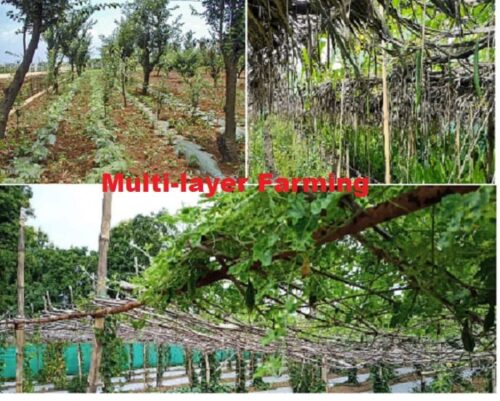
Multilayer Farming Model Maximizes the utilization of available farm resources, viz., land, labor, and capital
Multilayer farming is the cultivation of multiple crops of different heights and maturity periods on the same piece of land at the same time that are compatible with each other. It is the most common practice in fruit orchards and plantation crops for the maximum use of sunlight, even under high planting populations.
In other words, we can say that the cultivation of different compatible and mutually advantageous crops like vegetables, pulses, flowers, and fruits on the same field/land that is different in maturity days, plant height, plant root growth & development
Objectives of Multilayer Farming:
The multilayer farming practice has the basic objectives of growing multiple crops under a highly dense population structure to efficiently use the available resources like land, space, sunlight, air, nutrients, and water. Other objectives include:
1) To maximize the utilization of available farm resources, viz., land, labor, and capital.
2) To harvest the crops at regular intervals around the year.
3) To conserve the water resources of the farms
3) Reduction in the cost of crop production and input utilization.
4) To support organic and sustainable farming
5) To reduce the use of agrochemicals in agriculture.
6) To ensure the food and nutritional security of the household.
Advantages of Multilayer Farming:
1) Multilayer Farming reduces water evaporation from the soil surface due to 70% of the water is saved
2) Multi-layer farming practice increases the income per unit area (ensuring equal distribution of the farm income and Employment)
3) It reduces the risks of crop production losses.
4) It provides a continuous supply of farm produce all year.
5) Multilayer farming improves soil fertility by adding organic matter/humus to the soil.
6) Multilayer farming gives protection from the high-intensity rainfall
7) It reduces the process of soil erosion and landslides.
8) It increases the water-holding capacity of the soil
9) Multilayer farming increases biodiversity and creates unique microclimatic conditions, and such prevailing conditions create effective measures to control the incidence of weeds, pests, and disease
Disadvantages of the Multilayer Farming System;
1) It is highly labor-intensive.
2) Performing any type of mechanical activity in the field is not possible.
3) weeds, pests, and diseases can not be controlled chemically
4) Different crops may show adverse competitive effects.
How to Create a Multilayer Crop Structure:
1) Selection of Land ;
The land should preferably be square or rectangular in geometry. The area of the land depends on your selection of crops. Land should be highly approachable for frequent visits to observe the multiple crops.
2) Land Preparation;
Gently prepare the land for multiple-layer cropping. Various activities like primary tillage and secondary tillage should be properly performed. Apply farmyard manure and vermicompost to the soil as per requirements.
3) Pre-Sowing Field Treatments;
Apply fungicides to the soil before sowing to protect crops from various soil-borne diseases (due to the moisture level at the root zone, cause several fungi may attack.) 4) Building the Structure;
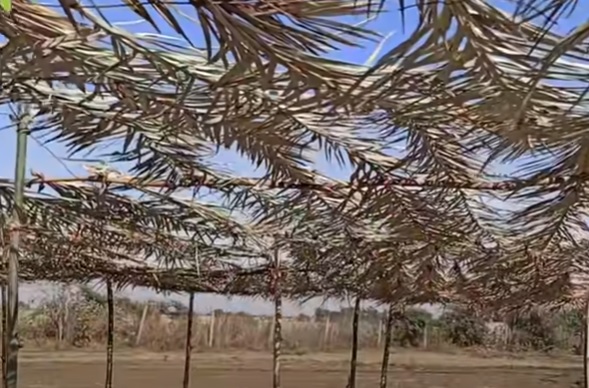
Building a house-like structure is the most important step of multilayer farming. It can be created by using bamboo or other wooden pegs. The frame of the roof can be made by knitting with small tangible wires, and after knitting, various grasses are spread over the roof to prevent direct sunlight.
5) It will be great if we cover the whole structure from all around. This can be done with the help of different types of grasses.
Multilayer Farming Model:
Let us understand the multilayer farming model with an example, step by step.
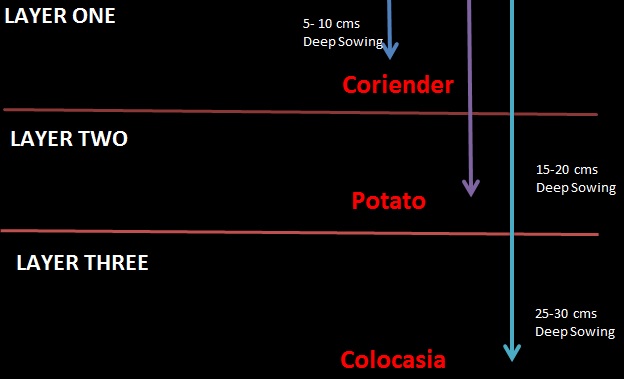
1) Crop Selection: Select the multiple crops that you want to grow and that should possess different germination and maturing periods. Let us select three crops Viz, colocasia, potato, and coriander, for multilayer farming. All the selected crops have different maturity and germination times, which are as follows:
Sow all the crops in Jan and follow the pattern as shown in the above picture. Major steps are as follows:
a) As we know from the above table, the Celecasia takes 60-90 days for germination and 210-240 days to mature. Based on this information, sow the Colocasia at a depth of 25-30 cm in the third layer.
b) Potatoes take 20-30 days for germination and 60-90 days to maturity; hence, it should be sown at a depth of 15-20 cm in the second layer.
c) while coriander takes 4-6 days for germination and 25-30 days to maturity, hence it should be sown on the top layer, ie Layer In this way, we have created all three layers.
3) Growth Pattern of the Different Crops;
a) As coriander is sown on the top layer, it will be ready to harvest in Jan itself we can harvest the coriander crop
b) As soon as we harvest the top layer crop, the potato that is sown in the middle layer (2nd layer) will germinate, and that can be harvested within 60-90 days.
c) Now, after the harvesting of the potato crop, the colocasia will germinate out and that can be harvested within 210-240 days
Hence, this way, we can take the production of 3 crops on the same piece of land, and this technique of crop production is called multilayer farming.
Note: The Celocasia crop will get harvested in October, and the field remains fallow for two months. You can plan to sow some other crop for the next two months.
Examples of Different Crop Combinations for Multilayer Farming:
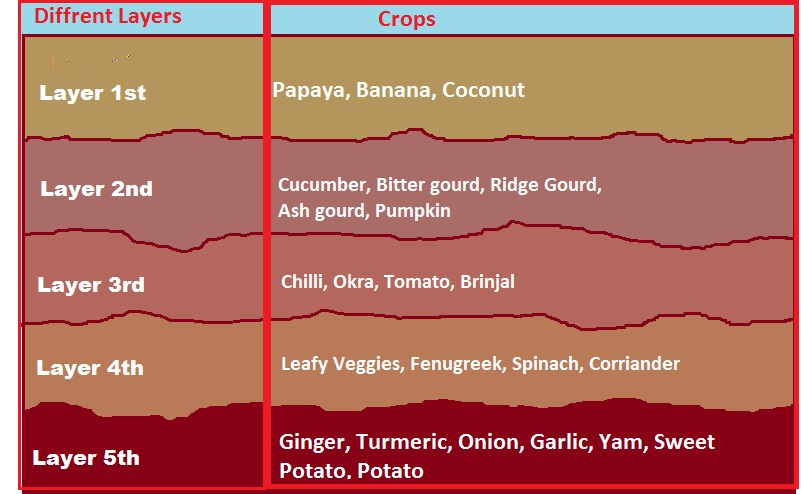
c) Suitable Crops for Different Layers in Multilayer Farming;
How plants grow under the Multilayer Farming System.
In multilayer farming, usually, 4-5 crops of different maturity periods and germination periods are planted on the same field. A few points must be followed while going for multilayer farming; these are as follows:
1) For the 5th layer, select the crop that grows and matures under the soil surface (roots and bulb crops), and these crops must have the longest germination period.
2) Consecutive crops of the middle layers (ie, Layer 4th to Layer 3rd) must have a high germination pace in comparison to their respective lower layer crop and a low germination period in comparison to their respective upper layer crop
3) 2nd layer crop should be the fastest-growing crop so that it leaves space for the growth and development of other crops
4) The top layer (first layer) crop should possess the following characteristics:
a) It should be mature at maximum height.
b) It should have a long-duration maturity
c) It should be planted less in numbers
d) Proper planting distance must be followed
Crop Management in Multilayer Farming System;
A multilayer farming system needs proper and timely crop management to get high production from each crop sown under this system.
1) Leafy crops must be harvested regularly and timely
2) Staking for the climbers should be properly arranged
3) Use the insect trap
4) Always use a shedding structure that should be comprised of bamboo and grasses and avoid Multilayer farming in open spaces; otherwise, quality and yield may get deteriorate
5) Irrigation should be properly managed; over-irrigation may cause damage to all the sown crops in this system.
Contains information related to marketing campaigns of the user. These are shared with Google AdWords / Google Ads when the Google Ads and Google Analytics accounts are linked together.
90 days
__utma
ID used to identify users and sessions
2 years after last activity
__utmt
Used to monitor number of Google Analytics server requests
10 minutes
__utmb
Used to distinguish new sessions and visits. This cookie is set when the GA.js javascript library is loaded and there is no existing __utmb cookie. The cookie is updated every time data is sent to the Google Analytics server.
30 minutes after last activity
__utmc
Used only with old Urchin versions of Google Analytics and not with GA.js. Was used to distinguish between new sessions and visits at the end of a session.
End of session (browser)
__utmz
Contains information about the traffic source or campaign that directed user to the website. The cookie is set when the GA.js javascript is loaded and updated when data is sent to the Google Anaytics server
6 months after last activity
__utmv
Contains custom information set by the web developer via the _setCustomVar method in Google Analytics. This cookie is updated every time new data is sent to the Google Analytics server.
2 years after last activity
__utmx
Used to determine whether a user is included in an A / B or Multivariate test.
18 months
_ga
ID used to identify users
2 years
_gali
Used by Google Analytics to determine which links on a page are being clicked
30 seconds
_ga_
ID used to identify users
2 years
_gid
ID used to identify users for 24 hours after last activity
24 hours
_gat
Used to monitor number of Google Analytics server requests when using Google Tag Manager
1 minute
Marketing cookies are used to follow visitors to websites. The intention is to show ads that are relevant and engaging to the individual user.
A video-sharing platform for users to upload, view, and share videos across various genres and topics.
Registers a unique ID on mobile devices to enable tracking based on geographical GPS location.
1 day
VISITOR_INFO1_LIVE
Tries to estimate the users' bandwidth on pages with integrated YouTube videos. Also used for marketing
179 days
PREF
This cookie stores your preferences and other information, in particular preferred language, how many search results you wish to be shown on your page, and whether or not you wish to have Google’s SafeSearch filter turned on.
10 years from set/ update
YSC
Registers a unique ID to keep statistics of what videos from YouTube the user has seen.
Session
DEVICE_INFO
Used to detect if the visitor has accepted the marketing category in the cookie banner. This cookie is necessary for GDPR-compliance of the website.
179 days
LOGIN_INFO
This cookie is used to play YouTube videos embedded on the website.